Images in this collection
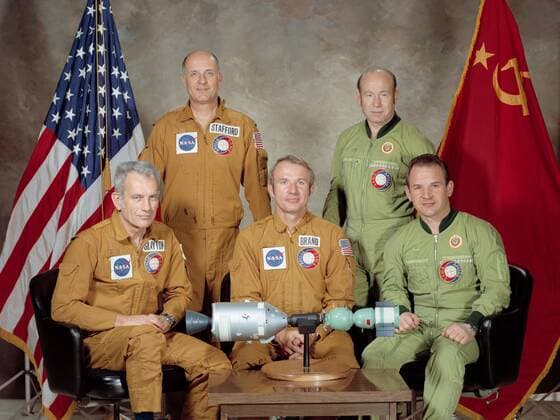
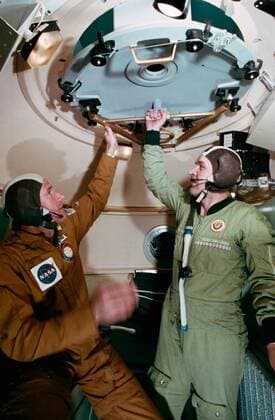
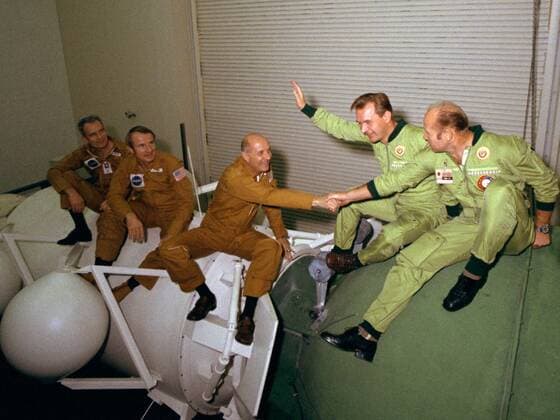
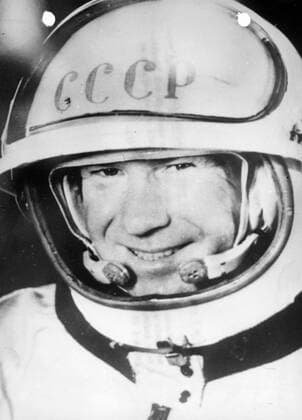
PICTURE SHOWS: The joint U.S.-USSR crew for the Apollo Soyuz Test Project in a group portrait. ... STORY COPY: ANNIVERSARY (17 July 1975): Cold War Rivals Met in Space On July 17, 1975, something momentous happened: two Cold War-rivals met in space. When their respective spacecraft rendezvoused and docked, a new era of cooperative ventures in space began. For more than a decade, American astronauts and Russian cosmonauts have been regularly living and working together in Earth orbit, first in the Shuttle-Mir program, and now on the International Space Station. But, before the two Cold War-rivals first met in orbit in 1975, such a partnership seemed unlikely. Since Sputnik bleeped into orbit in 1957, there had been a Space Race, with Copyright: xx 40719937 EDITORIAL USE ONLY. NOT FOR USE BY NEWSPAPERS BASED IN THE UK.
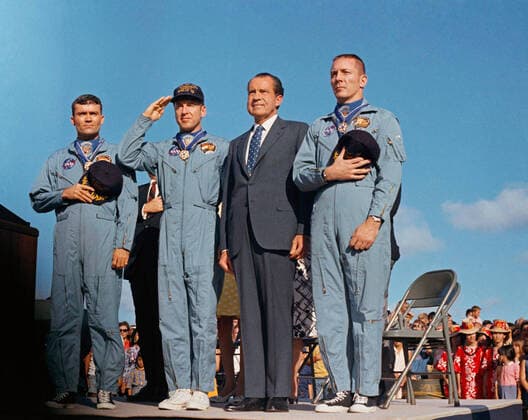
President Richard M. Nixon and the Apollo 13 crew salute the U.S. flag during the post-mission ceremonies at Hickam Air Force Base, Hawaii. Earlier, astronauts John Swigert, Jim Lovell, and Fred W. Haise were presented the Presidential Medal of Freedom by the Chief Executive. Apollo 13, launched on April 11, 1970, was NASA s third crewed mission to the moon. Two days later, on April 13, while en route to the lunar surface, a fault in the electrical system of one of the Service Module s oxygen tanks produced an explosion that caused both oxygen tanks to fail and also led to a loss of electrical power. With the mission aborted, a dedicated team in the Apollo Mission Control Center devoted their efforts to developing a plan to shelter the crew in the lunar module as a lifeboat and retain sufficient resources to bring the spacecraft and its WAX2020041303 NASA

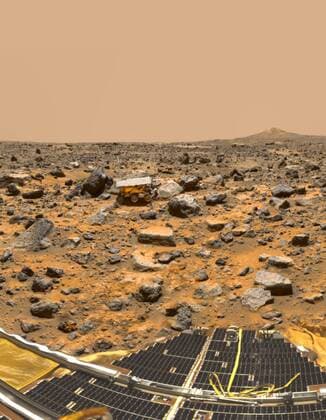
November 4, 1997 - This is a geometrically improved, color enhanced version of the 360-degree panorama heretofore known as the Gallery Pan, the first contiguous, uniform panorama taken by the Imager for Mars Pathfinder (IMP) over the course of Sols 8, 9, and 10. Different regions were imaged at different times over the three Martian days to acquire consistent lighting and shadow conditions for all areas of the panorama. At left is a Lander petal and a metallic mast which is a portion of the low-gain antenna. Misregistration in the antenna and other Lander features is due to parallax in the extreme foreground. On the horizon the double Twin Peaks are visible, about 1-2 kilometers away. The rock Couch is the dark, curved rock at right of Twin Peaks. Another Lander petal is at left-center, showing the fully deployed forward ramp at far left, and rear ramp at right, which rover Sojourner us Copyright: StocktrekxImages stk202209s