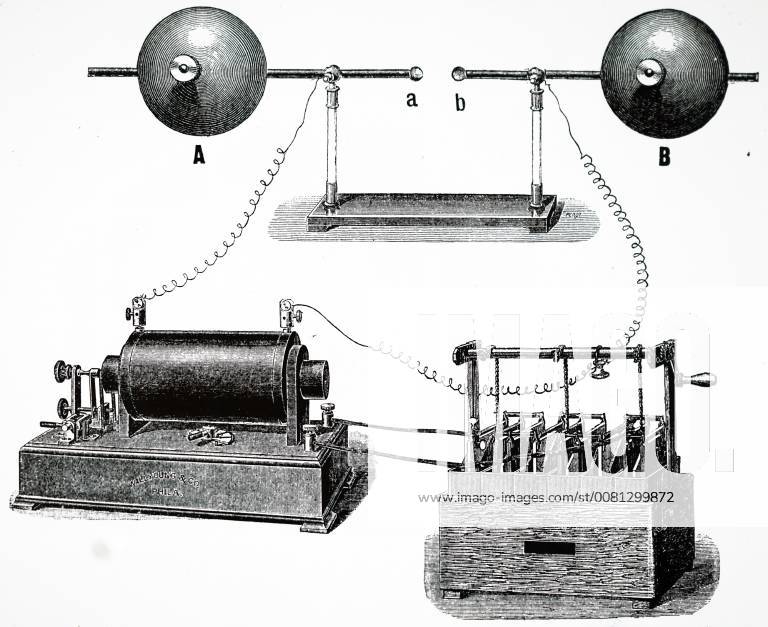
Illustration depicting Heinrich Hertz s experiment on electromagnetic waves: Hertz s oscillator. Terminals of an induction coil (bottom left) were connected to condenser A, B. Initial spark passing between metal balls at centre, A,B, formed a path for subsequent oscillations which were measured. Heinrich Hertz (1857-1894) a German physicist who conclusively proved the existence of the electromagnetic waves theorised by James Clerk Maxwell s electromagnetic theory of light. Dated 20th century 917_05_WHA_106_0034
Choose your license
Rights Managed:
One-time editorial use in an online article, social media channels, internal presentation, website, newsletter, or blog.
One-time editorial use in a book, newspaper or magazine (excluding cover page), external presentation. Limited to 5,000 circulation. This includes the rights available in the Standard license.
Media Info
Credit: UIG
Media ID:
Recording Date: Dec 19, 2017
Media Size: 5,069×4,138 Pixels
Illustration depicting Heinrich Hertz s experiment on electromagnetic waves: Hertz s oscillator. Terminals of an induction coil (bottom left) were connected to condenser A, B. Initial spark passing between metal balls at centre, A,B, formed a path for subsequent oscillations which were measured. Heinrich Hertz (1857-1894) a German physicist who conclusively proved the existence of the electromagnetic waves theorised by James Clerk Maxwell s electromagnetic theory of light. Dated 20th century 917_05_WHA_106_0034
Release Info: Do I need a release?
Captions may have been translated or enriched by an AI system.
For more information about AI-assisted captions, see AI-assisted captions.
Need a custom license?
If your intended use isn't covered by the available options (such as non-editorial purposes or specific distribution needs), contact us. Our team will be happy to provide a tailored offer based on your requirements.