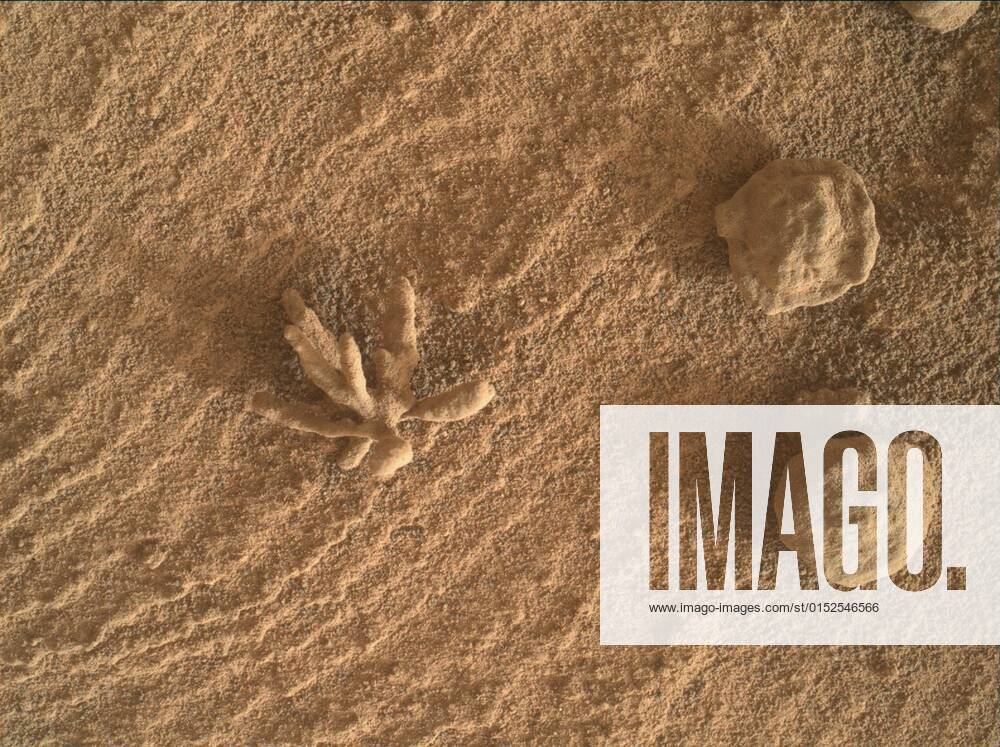
NASA s Curiosity rover has uncovered an intriguing flower formation on the surface of Mars that looks akin to an ocean coral. The microscopic view of Martian sand was taken with the Mars Hand Lens Imager (MAHLI), a tool for imaging minerals, textures and structures in rocks and soil at scales smaller than the diameter of a human hair. The Curiosity team confirmed it was a diagenetic crystal cluster , that experts from NASA JPL suggest may have been formed by minerals precipitating from water. While the formation looks large in size, it is actually smaller than a penny, and consists of three-dimensional crystal clusters made from a combination of minerals. NASA scientists say it can tell them more about the structure of Martian
Choose your license
Rights Managed:
One-time editorial use in an online article, social media channels, internal presentation, website, newsletter, or blog.
One-time editorial use in a book, newspaper or magazine (excluding cover page), external presentation. Limited to 5,000 circulation. This includes the rights available in the Standard license.
Media Info
Credit: Cover-Images
Media ID:
Recording Date: Mar 2, 2022
Media Size: 1,584×1,184 Pixels
NASA s Curiosity rover has uncovered an intriguing flower formation on the surface of Mars that looks akin to an ocean coral. The microscopic view of Martian sand was taken with the Mars Hand Lens Imager (MAHLI), a tool for imaging minerals, textures and structures in rocks and soil at scales smaller than the diameter of a human hair. The Curiosity team confirmed it was a diagenetic crystal cluster , that experts from NASA JPL suggest may have been formed by minerals precipitating from water. While the formation looks large in size, it is actually smaller than a penny, and consists of three-dimensional crystal clusters made from a combination of minerals. NASA scientists say it can tell them more about the structure of Martian
Release Info: Do I need a release?
Captions may have been translated or enriched by an AI system.
For more information about AI-assisted captions, see AI-assisted captions.
Need a custom license?
If your intended use isn't covered by the available options (such as non-editorial purposes or specific distribution needs), contact us. Our team will be happy to provide a tailored offer based on your requirements.